Search Results
339 results found with an empty search
- Botanist's Lens: Wind Flowers in Pink
If I had to pick one flower that has the most delicate shade of pink, and lasted throughout summer, I would definitely pick the Japanese Anemone flower. Anemone, comes from anemos the greek word for wind. "According to the Oxford English Dictionary, Greek anemōnē means "daughter of the wind", from ánemos the wind god + feminine patronymic suffix -ōnē (i.e. daughter).[9] The Metamorphoses of Ovid tells that the plant was created by the goddess Venus when she sprinkled nectar on the blood of her dead lover Adonis. The name "windflower" is used for the whole genus as well as the wood anemone A. nemorosa" Source: https://en.wikipedia.org/wiki/Anemone Isn't the meaning beautiful and very aptly suitable to the flowers featured? Anemome genus is another Ranunculus treasure with over 200 species. But don't get fooled by the faint pastel colors, these flowers are hardy, and Anenome as a plant is one you can count on for years to come. Anemone hupehensis, commonly called 'Japanese anemone,' does well in part shade and full sun. The common name however is misleading, they aren't originally from Japan. In fact, they are native to an eastern province in China. Anemones get to about 2-4 ft in height and are a great backdrop plant for your perennial garden. They can tolerate little dryness, but mostly prefer moisture for good flower blooms. They have a fibrous root system and the stems are woody at the base. Over time it does spread by underground stems. It is a great border/mass plantings perennial. I especially like them because, they bloom late summer and last well into fall when there aren't many soft color flowers. The foliage also has deep green color and lasts well throughout summer. In the pictures below, you will also notice the soft pearly buds on the rather long stems that help the flowers and buds dance freely in the wind. Anemones come in many colors, but pastel pink Japanese anemones steals the show! #anemones #anemone
- Botanist's Lens: Fragrant Jewels in the Gardens at London Town
London Town’s gardens have an excellent collection of specimen trees and shrubs, some happen to be exquisitely fragrant. I will be sharing with you today two of the many jewels that might easily go unnoticed to the untrained eyes. The first one is Franklinia alatamaha. "Franklinia is a monotypic genus in the tea plant family, Theaceae. The sole species in this genus is a flowering tree, Franklinia alatamaha, commonly called the Franklin tree, and native to the Altamaha River valley in Georgia in the southeastern United States. It has been extinct in the wild since the early 19th century, but survives as a cultivated ornamental tree" (Source) It was named by the famous botanist, John Bartram. "John Bartram was appointed Royal Botanist for North America by King George III in 1765. In that same year, John Bartram and his son William discovered franklinia growing in a 2-3 acre tract along the banks of the Altamaha River in southeastern Georgia." (Source) Yes, it is the same John Bartram who is mentioned on one of the interpretive signs in the exhibit area in the visitor center at London Town (read more in the picture). One more reason that Franklinia is special is that William Bartram named the Franklinia tree after Benjamin Franklin, also one of his father’s friend. Franklinia alatamaha, being a monotypic genus, is also good enough to make this plant special. But it is the Camellia-like cream colored, cup shaped fragrant flower, the bright fall color and its extinction from the wild, that make this a very sought after understory plant. Pictured up top is the newest member of the garden, a Franklin tree blooming in its first year. Thanks to Stanley Smith Horticultural Trust for a grant that allows us to rebuild a lost collection of specimen trees and shrubs. Let’s now look at another fragrant shrub that is otherwise hard to grow in Zone 7 but is thriving at London Town, Clerodenron trichotumum. "The flowers have an airy, sweetly delicate grace and are large enough to make an eye-catching show. The red calyx persists as the fruit develop into small bright blue berries making a very colorful combination". (Source). It is also commonly called as the "peanut butter tree" because when the leaves are crushed, they smell like peanut butter. Most decadent though is the smell of the flowers, which are similar in shape and fragrance to a Jasmine flower. I distinctly remember collecting Clerodendrum inerme flowers from my grandfather’s garden hedge. C. inerme grows profusely in India and is salt tolerant. Clerodendrums hold a special place in my memory because of the fragrance of the flowers I gathered as a child. Odor evoked memory is another beautiful way to connect with nature. As they say, always stop and smell the flowers! #franklintree #franlinia
- Botanists Lens: Pollinator and Rain Gardens
Enjoy watching the pollinator garden transformation, including the first Monarch butterfly of the season! The restoration process for this rain/pollinator garden started back in 2016, and through the years, we have cleared 25+ tree saplings, many unwanted weed and vines and then added three layers of shrubs and small plants to support a rain garden and create a 'healthy sustainable habitat' for the many pollinators. Restoration stage 1 2016: Identifying rain garden problems including, large tree saplings overgrown and overcrowding the drain and other plants Restoration stage 2 2016: removal of trees and saplings to clear the land for new plantings suitable for a rain/pollinator garden Restoration stage 3 2017: Pollinator species planted including middle layer of tall shrubs, Joe Pye Weed, Milkweed, Hibiscus Restoration stage 4 2018: More pollinator species planted with the help of various Eagle Scout groups. Bed amendments also added in. Restoration stage 5 2018: Completion of restoration with more plantings of lower layer of shrubs and ornamentals like Redbeckia, Clethra, Iris, Callicarpa, etc. 2019: Swallow tails enjoying their habitat 2019: First Monarch of the season enjoying Clethra 'Rubyspice' #raingarden #bioretentionpond #restoration #milkweed #habitat #pollination
- BotanistLens: Commensalism, "Hitching a Ride"
Plants/organisms that live together share different types of relationships that either benefit both or benefit at least one partner or one where the host is harmed. Symbiotic relationships wherein one partner is benefited, but the other is harmed are the Parasitic relationships. There are many type of fungi that act as parasites on plants. A common example of a plant considered to be parasitic is Mistletoe. It shares a parasitic relationship with its host. It doesn't kill the host, but it is certainly is harmful to the host while it is hitching a ride for its growth. 'Galls' seen on some plants are a good visual that a parasite has been at work at the host tree, eventually harming it. Then there are symbiotic relationships that can be mutually beneficial to both, for example, Lichens. The algae live inside the filaments of fungi and form a composite organism called Lichens. Leafy Lichens are in fact a good sign that the air around that organism is clean and healthy. But "Lichens are often blamed for killing a tree or shrub but this is not true. They do, however, grow on slow growing and sometimes declining trees and shrubs" ( Source: https://extension.umd.edu/hgic/topics/lichens) The relationship that doesn't get much attention is 'commensalism,' basically seen as one plant 'hitching a ride' on another, where one is benefited, but the other isn't harmed. The plants that receives benefits is kinder to the host, at least for most of its life cycle. Most vines are a good example, where the climbing vine needs the support of trees to climb, but the vine isn't harming the host or deriving nutrients from the host and killing it slowly internally. Ivy growing on vines can be eventually detrimental to the host, but initially it is just hitching a ride. Other examples of commensalism include Spanish Moss on trees and Orchids and many other epiphytes growing on host tree One commensalism relationship I noticed on my walk in the gardens recently was the relationship between creeping hydrangea and Persimmon trees in the gardens. See the picture where the two trunks of the creeping hydrangea vine (Hydrangea petiolaris) seem to be choking the host tree, but they aren't really harming the tree. They are simply hugging the tree, hitching a ride for their upright growth in order to have a fuller life cycle. Based on the size of the trunks you can tell they have shared a commensalism relationship for many decades. In fact, the Persimmon tree has aged and is on a decline where it could drop any minute, but I wonder if the roles have reversed and the hitchhiker is giving the host its much needed support. On a different note, a simple example of commensalism between animals and plants is frogs using Lily pads to sit on waiting for a prey, wherein it isn't harming the Lily pad but using its support. I don't have a picture of that cute frog, but I am sharing today a picture of the ornamental gardens with the south river as a back drop to the Lilies. Summer is gorgeous! Visit London Town's deep shade woodland gardens to beat the heat this weekend. #commensalism #symbiotes #parasites
- Botanist's Lens: Stuck on Stargazer!
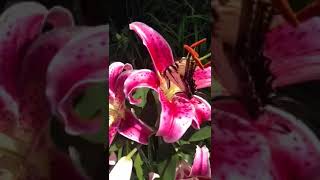
Not just the swallow tail in the video below seems stuck on the gorgeous Lily, but I am too! Oriental lilies are considered be one of the most attractive cut flowers. Bright colors, petal size, varieties, there are ample Lilies to choose form. But once you lock your eyes with Lilium orientalis 'Stargazer,' you will probably not choose any other lily. The fragrance is deep and the colors give even more depth. Also, most lilies are downward or sideways facing, but the 'Stargazer' is upward facing, hence the beautiful name which literally refers to flowers being open faced, gazing at the stars! 'Stargazer' was a variety developed by Dr. Leslie Woodriff in the late 1970's. "Stargazers are easy to grow and do best in full sunlight. They have a fast growth rate and should be planted in full sun in well-drained loamy or sandy soil. When mature, 'Stargazers' can grow to a height of 36 inches with a spread of 10 to 14 inches with 2 to 8 flowers per stem" (Source). But if you have cats as pets, steer away from the 'Stargazer' "The ASPCA reports this plant as being toxic to cats. You can read more about the numerous Lily hybrids on the following link. 'Stargazer' is commonly available and easy to establish. Plant your blubs in early fall to cherish the blooms in mid-June the following year. Summer is also a good time to plan for fall bulbs/perennials to plant. Lilies, gladiolas, even Black Eyed Susans can fill up a garden palette with vibrant colors during the hottest weeks. Mid summer is a good time to scout your garden for spots that are in need of color between the July-Sept. Daylilies are a good filler and you can plant so much in combination with them to have a mid-late summer blossoming garden. For sure though, Black Eyed Susan and 'Stargazer' lilies will be the most promising in terms of color year after year! #stargazer #lilies
- Botanist's Lens: Purple Defense
Calla lilies come in a variety of colors. Callas are true ornamental flowers that exude elegance, style and beauty from all angles and in all shades. One single Calla flower in a vase is probably way more elegant than a bountiful collections of summer cut flowers. Very aptly named, the origin of the word Calla comes from the Greek word for beauty. Also, Callas lilies are not true Lilies; they belong to 'Araceae' family (arum family) and not Liliaceae of the lily family. In the pictures, you will notice the deep dark purple flowers and pink callas growing in the new flower beds at London Town. (The William Brown House is a gorgeous backdrop behind this flower bed!) The deep purple is a stunning backdrop to any planter and even more to the light tan pea gravel in the beds. I picked the Callas for its elegant form and rich color contrast. But also because it is a good example to show children that not all flowers are pink, red or yellow. They can be black, deep dark purple, and shades of green sometimes. When I walk by these deep purple Callas, it more often catches my eye for the super pigments present inside the flowers that give it the rich purple color. The 'Flavonoids' - mainly 'anthocyanins pigments' - are responsible for the many flower colors like blue, purple and red. They help in plant defense, mainly against abiotic and biotic stresses such as: UV radiation, predators, oxidative stress and much more. "Flavonoids represent a wide group of plant secondary metabolites implicated in many physiological roles, from the attraction of pollinators to the protection against biotic or abiotic stresses. Their role as developmental regulators of auxin transport and catabolism and the protection against UV radiation are considered the most ancestral functions of these phytochemicals" Source In last week's Botanist Lens post, we looked at 'phytochemicals' and how they benefit human health. "Yet flavonoids are not present in plants for human benefit. They fulfill many disparate biological functions, mostly mediating interactions between plants and the environment: animal attractants for pollination and seed dispersal, signalling molecules in plant-microorganisms interactions, or participating in plant defense against pathogens. They are also involved in the mechanisms of tolerance to practically all types of abiotic stress, including UV radiation, extreme temperatures, ozone exposure, drought or salinity" Source Callas are more successful when grown in pots in zone 7, but you could try some hardier varieties in the ground. They like moisture but not stagnant water. If you have planted Callas and they aren't blooming, try giving them more drainage and amend the soil. Plant defense mechanisms are complex. Evolution of plant defense is super diverse and highly impressive to say the very least. Leaving you with another article "Anthocyanins have also been implicated in the camouflage of plant parts against their backgrounds, in the undermining of insect crypsis, and in the mimicry of defensive structures". Source #callalillies #callas #flavonoids #araceae
- Botanist's Lens: Solanum Happy
Could Solanum vegetables make you happy? Can eating right vegetables and fruit enhance your health as well as your mood? Well, Eggplants might just be one of the items you should add to your diet for sound sleep. The first time I heard about 'Phytochemicals' was during a botany lecture when we were taught that eating eggplants could make you happy due to the significant amino acids such as 'Tryptophan' levels present in it. Now, that didn't quite make me start liking eggplants right away, but it certainly left me intrigued to learn more about the plant families that have essential phytochemicals that have significant impact on human health. Here are few interesting facts and articles: "Phytochemicals are a large group of biologically active agents found in plants. Often, they have a therapeutic capacity, working as anticarcinogenics, antimutagenics and anti-inflammatory agents. Common fruits and vegetables are often quite rich in phytochemicals" (https://www.scientia.global/dr-c-b-rajashekar-more-reasons-to-eat-your-greens-boosting-phytochemicals-in-vegetables/?fbclid=IwAR0H_MMVKwf4NdKrBC3TfMNzSiBrpbQi8qa6JjlfJjftgRf2xs1T44XSfgw) "Scientists estimate there are more than 5,000 phytochemicals, and we're only beginning to understand what the compounds may do for human health" (https://www.health.harvard.edu/staying-healthy/fill-up-on-phytochemicals?fbclid=IwAR0rxDd-fchgPhY5oIpoRNSfQLWAs3vi5t7fhzdMwyiUG4d92kMPjg0L4js) It is important to remember that research is still ongoing and phytochemical benefits aren't yet completely conclusive. Eggplants contain Tryptophan which is a plant derived amino acid that is important for the production of serotonin in our body. Our bodies cannot make tryptophan and we need to obtain it from the right diet. There are many more benefits of eating Solanum species: https://www.ncbi.nlm.nih.gov/pmc/articles/PMC5986471/?fbclid=IwAR2SJ9nrlJZgmI2bygN8K-VgZomNqL00wEt-86ysfl3vxRsygeorTMEsGa4 "The Solanaceae family is one of the largest and most complex of the Angiosperms. It has species rich in active secondary metabolites and very important from economic, agricultural, and pharmaceutical point of view, especially the Solanum genus, one of the largest in the plant kingdom" (https://www.ncbi.nlm.nih.gov/pmc/articles/PMC6268556/?fbclid=IwAR1taqZ0GefKNO8KdLU6D_15b6ppbwoycYXP--YKS2vkJeLvRBMd-FCiA5E#B11-molecules-17-12560) The nightshade (Solanaceae) family consists of many vegetables including eggplants, tomatoes, chili peppers and potatoes. Now it might be hard to get children (or adults) to start adding eggplants or tomatoes to their diet, but it is certainly easier to add "raspberries" (Rosaceae). Berries are loaded with antioxidants! The pictures are from our brand new demonstration garden beds (thanks to a grant received from the Arts Council of Anne Arundel County) that has different vegetables growing in it. When you visit Londontown next time, take some time to show children all the delicious and phytochemical loaded cabbage, eggplants, corn, tomatoes, zucchini and many more vegetables. But most of all, talk to your children about the phyto (plant) chemicals present in these plants. Those are the superheroes that our bodies need to be truly happy!
- Botanist's Lens: You See Yellow, They See UV!
In the spirit of 'National Pollinator Week' and a wonderful 'Pollination Exploration' workshop being held at London Town tomorrow (Sat. June 22nd 10am-12pm), I thought of speaking to you today about, colors as pollinators, such as bees, see it. Did you know that bees see colors totally differently than humans can? Humans normally see colors between the wavelengths of 390-750nm (nanometers) and bees can see approximately between 300-650 nm. Simply put, bees can see Ultraviolet (UV) wavelengths. Bees see patterns very differently than humans. "Biologists working with ultraviolet patterns in the flowers of temperate species have shown that the flowers of about 33 percent of all species strongly reflect ultraviolet light. About seven percent of all flowers show floral patterns in ultraviolet light that are not evident in visible light. For example, in the black-eyed Susan (Rudbechia hirta) there is an ultraviolet-absorbing region caused by the presence of flavonols, a class of chemical pigments (Thompson et al., 1972). Flavonol-containing flowers are usually yellow in the visible spectrum, a tendency perhaps due to the fact that many flavonol pigments found in petals both absorb ultraviolet light and reflect yellow light. "Cornus florida, which appears to be one large four-petaled flower but is really composed of four bracts surrounding many small flowers. In both this species and the Korean dogwood (Cornus kousa) the bracts appear white and the small central flowers are yellowish green in visible light. However, in ultraviolet light the pattern is reversed: the central flowers appear highly reflective and the large bracts dark." You can read more information in the following link. So how do you create a color pallet for bees in your garden? Should you? Most botanists and researchers would say to add as many patterns and colors in your pollinator garden as possible. Planting flowers in clumps is a good approach for a pollinator garden. Bees usually get attracted to blue, purple, yellow, white and violet, but plant as many patterns and color combination as your can. Because flowers are usually pollinator generalist. "Pollinator colour preferences seem to condition plant–pollinator interactions, the selective force behind these preferences has not been strong enough to mediate the appearance and maintenance of tight colour-based plant–pollinator associations." You can read more information on the following links: https://academic.oup.com/aob/article/118/2/249/1741474 http://www.helpabee.org/specialists-vs-generalists.html The pictures are part of a pallet I am planting for a small bee garden at London Town. Mix patterns and colors, add heights and give your bees ample choices. Note that the purple-blue flower below is a mophead hydrangea. As gorgeous as it is, it will do no good to your bees since most mophead hydrangeas are sterile. Here is a another neat link about what bees like. 'Bee' a resourceful gardener and most of all, teach kids about bees. Because...bees matter! #pollinator #bees #cornus #hydrangea #uv
- Botanist's Lens: Stalwart Stewartia
If I had to pick the best of all small trees, I would most definitely pick 'Stewartia pseudocamilla' to be the winner. It belongs to the Theaceae family (tea family) of which camellias are most popular. In contrast to most camellias, Stewartias are deciduous and don't have the leathery green color to their leaves. The leaves of Stewartia are delicate, with slightly serrated margins. The most striking feature of the leaves is its superb hues of orange, red and bronze -brown in fall, very similar to a sugar maple. Once you place a Stewartia in the right location, you will enjoy it all four seasons. The bark has a stunning pattern with a mixed pallet of brown, red, gray, terra cotta, and cream. The pattern of this peeling bark can be enjoyed year round, but ofcourse being a deciduous tree, the architecture of this small tree is best enjoyed when only the bark and stems are visible. The flowers of Stewartia resemble closely to Camellia sinensis (tea plant) wherein the petals are creamish white, with the most delicate appearance. Its hard to tell, if the flowers look better hanging down from the stems or fallen near the base of the trunk. These delicate flowers give the most ethereal look to the whole tree structure. They come out in June and the blossoms are abundant. Stewartias however don't establish easily. They also dislike extreme heat and drought. But once placed in a right spot, they will be the stalwarts in your garden for years to come. Bark, leaves, flowers, seed pods, tree architecture, its difficult to pick one best feature, because all of these features are the best ones a small tree could have. Combine the best bark color, flower shape and leaf color into one and you have a winning small tree which never disappoint anyone, in any season. We are lucky that we can grow this stunning Japanese beauty in zone 7! Although not popular in the nursery trade, it can be found in many arboretums and botanical gardens. Thanks to the Stanley Smith Horticultural Trust for awarding with us a grant that now enables us to establish a lost collections of Stewartias in our spring walk, along with the Franklin tree and many other specimen trees. Come and enjoy the Stewartia blossoms at London Town this weekend. #stewartia #camellia #theaceae
- Botanist's Lens: Spot a Sport
Have you ever spotted any sports in your yard or other gardens? Nope, I am not talking about sports as in basketball, football or cornhole, but in the world of Botany and Horticulture a 'sport' is a totally different ball game! A 'sport' in the botany world means a 'genetic mutation;' one that has no explanation and no specific rhyme or reason for its occurrence. Sport is a chance genetic mutation and can occur on any plant, anytime. A sport is a part of a plant, for eg., flower, leaf, buds, that shows a morphological difference than the rest of the plant. Plant morphology (the study of the plant parts) was one of my most favorite topics in botany and when you mix genetics with it, a whole new world opens up! Genetic mutations simply put, are changes in the genetic sequence and can be heritable. Now let's see how you could spot a sport! If you have strolled through London Town's gardens when the Azaleas are in bloom, you have probably noticed some Azaleas that show a totally different flower color amongst the others. That's a sport! For eg. in the picture below you will notice that amongst the white Azalea flowers one of the flower is half pink and half white. Sometimes, a small bunch of flowers turns a different color than the original flower color of the plant, for no rhyme or reason. Most of the Azalea sports at London Town are amongst the evergreen Azaleas, like in Satsuki Azaleas and Glen Dale Azaleas. Spotting a sport in an Azalea is exciting for plant breeders, because it gives a chance to propagate that part of the plant to replicate the sport, if it has an interesting trait. Spotting a sport is not restricted to flowers alone. You can spot sports on leaves and buds too. For eg., plants that usually have all green leaves, sometimes show a couple of leaves with yellow or white streaks. That's a sport! Help us spot sports when you visit London Town garden next time. If you visit us in the coming weeks, you might still be able to spot some sports in late blooming Azaleas. Mutants are fun! After all, they play a significant role in evolution. Now that's definitely my kind of sport! #sport #azaleas
- Botanist's Lens: Senescence in Flowers
Senesce or senescence is the biological process of aging, abscission and eventually death. Flowers usually have the shortest period of longevity amongst all plant parts. Flowers senescence can be gradual or quick. Senescence brings us the question of deadheading. Is it important to deadhead? The answer is no. For eg., rhododendrons don't need to be deadheaded after even flower goes through senescence and death. Deadheading doesn't affect the natural function of the plant. However, deadheading of spent flowers does make the plants more aesthetic and in some cases pushes for more flower production. For eg. in pansies, if you pick the withering flowers before they completely die, it pushes the plant to keep producing more flowers. The plant's ultimate goal after all is reproduction and seed production. If flowers are pinched off in some species, the plant puts more energy towards making more flowers to try everything it can for seed production. In some cases, it is possible to halt or extend the natural senescence and allow the flower to keep going for a while. Good examples are cut flowers, like roses and carnations that you can buy with plant food. Once added to water, the plant food allows the flowers to push senescence and keep flowers fresh for extended time. But eventually senescence occurs and they wither. I recommend deadheading for Rhododendrons, Azaleas, Peonies, Daylilies, Rudbeckias, Shasta Daisies, all for aesthetic reasons. Deadheading is especially good to deadhead Lavender stalks to keep a round form of the plant. Also, there are ample uses for dried lavender! However, if you want to let the flower set seed, then leave it alone and let nature take its course. As refreshing as new growth is, so is senescence to me. It is a reminder of the natural life cycle and seed production in plants. Included are pictures of a Southern Magnolia showing senescence. Look how gorgeous the bronze beige petal color is. Also, notice the inner seed stalk that is getting the signal to grow full swing, now that the flower has ceased its growth. As you add new plants, think about the period it takes for the flowers to get to senescence, how long do they hold their shape, will they need to be deadheaded to keep up with aesthetics, and finally could you use them as cut flowers indoors and prolong their senescence to get most of the flower? If you want prolonged senescence in a flower, then I would say a hybrid tea rose is a winner. Like the yellow tea hybrid rose pictured below (a new addition to London Town's gardens) will last for a really long time in your yard as well as in your vase! #deadheading #southernmagnolia #tearose #senescence #senesce
- Botanist's Lens: Save the best for the last!
Now that most spring blooming flowers have wrapped their show, the highlights of early summer flowers have just started blooming at London Town. Of all the Magnolias, the Southern Magnolias (Magnolia grandiflora) are the grandest and the largest. Their evergreen, leathery and glossy leaves steal the show by themselves. But as soon as the first white blossom opens up, that one flower can steal the whole show! London Town has at least 5 mature Southern Magnolias, with 'DD Blanchard' being the best of the bunch. The underside of the DD Blanchard leaves have a rusty brown color and their flowers have a cup shape. Southern Magnolias are often found in moist woodland and hardwood hammocks. They are excellent as a specimen tree or shade tree. Illicium henryi is another late spring to early summer bloomer at London Town. Aesthetically speaking, Illicium (Star Anise) can be the star of any shade garden; the elegant soft rose pink droopy flowers are absolutely breathtaking. But wait till you learn more about how botanically important and ancient this plant is. The Latin name 'Illicium' comes from Latin from 'allurement' which refers to the aromatic scent of leaves when crushed. To me they smell exactly like crushed Mango leaves (Mangifera indica). Illiciums belong to the moist understory and shady habitats. Illiciums are one of the oldest Angiosperms in the chain of evolution. In fact, their vascular tissues are more similar to gymnosperms than angiosperms. In the coming weeks, if you visit London Town, be sure to trek down the woodland garden paths to find Illicium henryi and then on to the ornamental gardens to cherish the beauty and fragrance of the Southern Magnolia 'DD Blanchard'. Both these plants are great addition to any garden that gets dappled shade. #mayapples #turtles